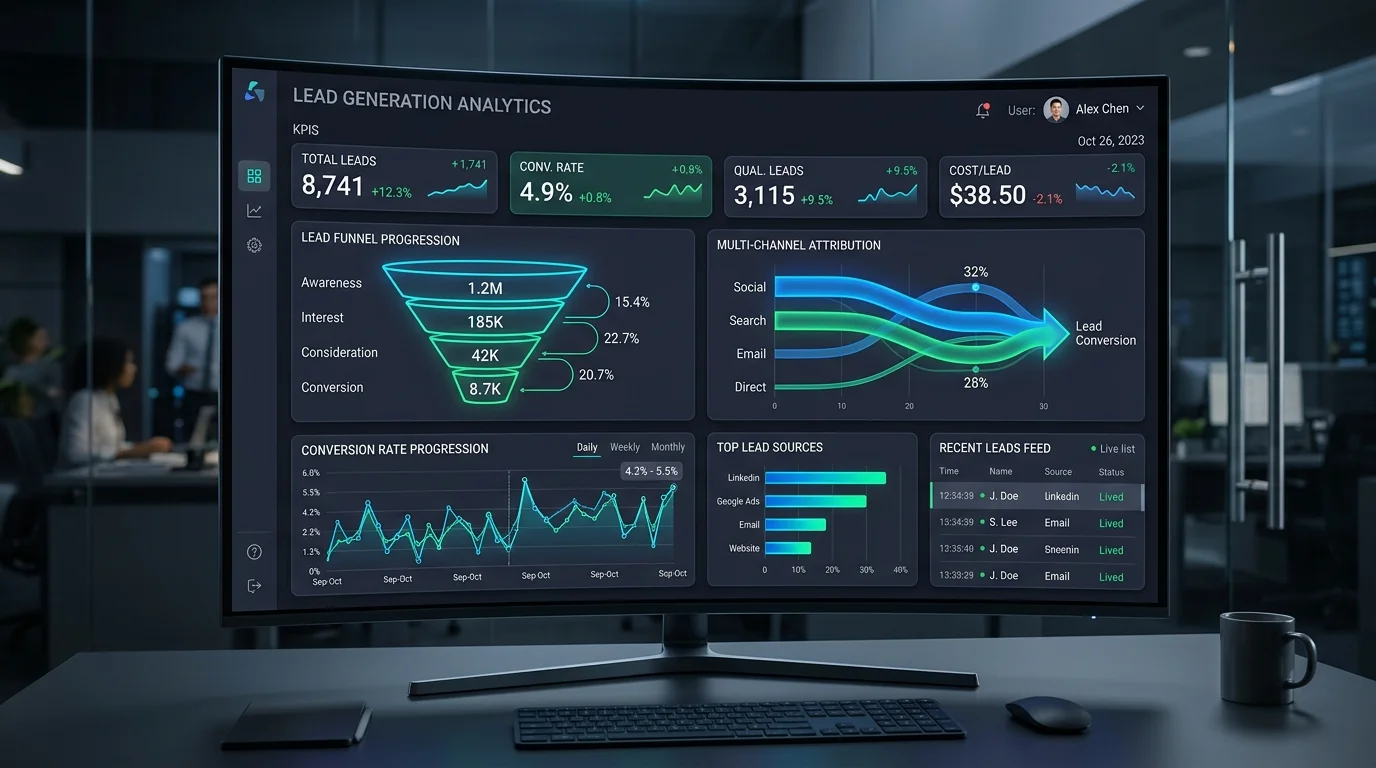

One of the most frustrating scenarios for any business owner or marketing leader is watching Google Analytics report thousands of monthly website visitors while the sales inbox remains empty. You see the traffic graphs climbing, search impressions expanding, and organic rankings improving, but phone calls, contact form submissions, and qualified enquiries fail to materialize.
When a website attracts traffic but fails to generate leads, teams often jump to the wrong conclusion: they assume they simply need more traffic. They double down on generic blog posts or ramp up paid ad spend, only to discover that multiplying unqualified visitors simply increases bounce rates without moving revenue.
The reality is that website traffic and lead generation solve two distinct halves of the digital equation. Traffic represents visibility; conversion represents relevance, credibility, and frictionless action. If there is a breakdown anywhere along the journey from search query to enquiry form, your traffic will evaporate without creating commercial value.
Below is a comprehensive breakdown of 11 critical SEO, UX, and conversion problems that explain why your website gets traffic but no leads, along with practical steps to diagnose and resolve them.
1. Search Intent Mismatch (Informational vs. Commercial Intent)
The single most common reason for high-traffic, zero-lead websites is targeting search queries with purely informational intent rather than commercial or transactional intent. If your traffic is driven by broad top-of-funnel queries—such as "what is a website wireframe" or "free invoice template"—visitors are seeking quick answers, definitions, or DIY solutions. They are not looking to hire an agency, purchase software, or book a consultation.
While informational traffic is useful for brand awareness and domain authority, it must be balanced with high-intent commercial keywords. Aligning your search engine optimization strategy around bottom-of-funnel intent ensures you attract decision-makers actively evaluating solutions rather than casual researchers.
2. Attracting the Wrong Audience with Vague Keyword Targeting
Ranking for high-volume keywords sounds impressive in monthly marketing reports, but volume is meaningless if the audience has no purchasing power or geographic fit. For example, ranking globally for a generic keyword when your business provides localized B2B services will flood your analytics with international visitors who cannot become customers.
To fix this, refine your keyword architecture around specific service offerings, buyer industries, and geographic parameters. Qualifying search intent through precise keyword modifiers filters out tire-kickers before they ever click your link.
3. Misleading Page Titles and Meta Descriptions
Your search snippet in Google results—the meta title and description—acts as a digital promise. If your title promises a specific pricing calculator, free audit tool, or instant quote, but the destination page presents a generic sales pitch or demands an immediate consultation call, visitors feel misled and immediately hit the back button (pogo-sticking).
Ensure that every title tag and meta description accurately previews the exact content, tools, and value proposition found on the page. Transparency builds immediate trust.
4. Landing Page Content That Fails to Match the Search Query
When a visitor clicks a search result, you have less than three seconds to confirm they have landed in the right place. If a user searches for "custom PHP web application development" and lands on a homepage displaying a generic "We Build Digital Solutions" banner with no mention of PHP or web apps, cognitive friction occurs.
Every key service offering requires a dedicated, conversion-optimized landing page engineered through modern website design principles. The headline must immediately echo the search query and provide a clear answer to the visitor's underlying problem.
5. An Unclear or Weak Value Proposition Above the Fold
First-time visitors will not read three dense paragraphs to figure out what your business actually does. If your hero section relies on vague corporate buzzwords—such as "Empowering Digital Synergies" or "Transforming Tomorrow"—visitors cannot quickly determine your relevance.
A compelling value proposition should answer three foundational questions within seconds:
- What exact service or product do you provide?
- Who is it designed for?
- What specific business outcome or advantage does it deliver?
6. Weak, Confusing, or Premature Calls to Action (CTAs)
Many websites suffer from one of two CTA extremes: they either bury their contact link in the footer, or they assault early-stage visitors with aggressive "Buy Now" or "Book a 60-Minute Demo" buttons before establishing value.
Structure your call-to-action hierarchy based on page context:
- Primary CTAs: Direct actions for high-intent visitors (e.g., "Request a Custom Proposal", "Speak with an Engineer").
- Secondary CTAs: Low-friction actions for evaluative visitors (e.g., "View Case Studies", "Download Implementation Guide").
7. Frustrating Mobile User Experience (Mobile Traffic Gap)
Over 60% of all organic search traffic originates on mobile devices. If your desktop website looks pristine but your mobile experience suffers from cramped tap targets, unreadable font sizes, horizontal shifting, or intrusive popups that block the viewport, mobile visitors will abandon your site instantly.
A robust web development architecture ensures full responsive fluidity, fast mobile touch ergonomics, and streamlined navigation across all device viewports.
8. Slow Page Speed and Cumulative Layout Shifts (CLS)
Website speed is not just a search ranking signal—it is a direct conversion bottleneck. Research shows that every 100-millisecond delay in page load time reduces conversion rates by up to 7%. Furthermore, unexpected visual shifts (CLS) where buttons jump while a user attempts to tap them destroy credibility.
Audit your Core Web Vitals regularly, compress media into modern WebP formats, eliminate bloated JavaScript libraries, and ensure your server delivers rapid time-to-first-byte (TTFB).
9. Absence of Tangible Trust Signals and Social Proof
Online buyers are inherently risk-averse. If your website lacks verifiable evidence that you have successfully delivered results for similar clients, visitors will hesitate to submit their confidential contact information.
Integrate real trust signals directly into your conversion path:
- Verified client testimonials with real names and companies
- Detailed case studies showing before-and-after metrics
- Industry security badges, certifications, and GST/legal business credentials
- Client logos and portfolio demonstrations
10. Overcomplicated Enquiry Forms and Broken Lead Paths
Asking for 12 form fields (including company revenue, fax number, and full mailing address) on an initial contact form introduces massive abandonment. Every additional form field decreases submission rates.
Keep initial enquiry forms frictionless: ask only for essential information (Name, Email/Phone, and Project Summary). Furthermore, test your form submission scripts regularly to verify that notifications, auto-responders, and CRM webhooks are functioning flawlessly.
11. Content That Informs but Fails to Create Commercial Momentum
Publishing comprehensive, educational blog posts is essential for SEO, but informational content must not be a dead end. If an article thoroughly explains a complex technical challenge without guiding the reader toward professional implementation support, the visitor consumes the free information and departs.
Incorporate contextual internal links, inline summary boxes, and relevant service recommendations throughout your informational content to create a natural transition from learning to hiring.
How SEO and Conversion Rate Optimization (CRO) Must Work Together
SEO and conversion optimization are two sides of the same coin. SEO brings the right audience to the doorstep; CRO invites them inside and makes taking action effortless. When you align keyword selection, page hierarchy, copywriting, and technical performance into a unified funnel, your conversion rate scales sustainably.
Diagnostic Audit Checklist: How to Find the Leak in Your Funnel
To identify why your website is leaking potential leads, perform this sequential audit:
- Analyze Traffic by Landing Page in Google Search Console: Identify which specific URLs generate the most clicks and review their search query reports.
- Review Device Breakdown in Analytics: Compare desktop conversion rates versus mobile conversion rates. A significant divergence indicates mobile UX problems.
- Evaluate Scroll Depth and Session Recordings: Check if visitors are reaching your CTA sections or dropping off above the fold.
- Set Up Custom Event Tracking: Use web analytics and tracking to monitor form impressions, form starts, and form submissions to pinpoint exact abandonment steps.
Frequently Asked Questions (FAQ)
What is a good website conversion rate for B2B service websites?
For B2B service agencies and professional firms, an average website conversion rate typically ranges between 2% and 5%. High-intent landing pages targeted at specific service queries can achieve conversion rates of 7% to 12% when properly optimized.
Can high traffic actually hurt my website if it does not convert?
High unqualified traffic does not directly penalize rankings, but if visitors frequently bounce back to search results within seconds, it signals poor relevance to search engines. More importantly, it skews your business metrics and wastes marketing resources.
How long does it take to see lead improvements after fixing UX issues?
Unlike organic SEO ranking improvements which take weeks to mature, UX and conversion fixes often produce immediate results. Simplifying enquiry forms, fixing mobile layout bugs, and clarifying CTAs can improve lead flow within days of deployment.
Should every blog post have a contact form?
Not necessarily a full contact form, but every blog post should include clear contextual links, relevant service CTAs, or low-friction lead magnets that offer a logical next step for readers seeking professional assistance.
How do I know if my keywords are attracting the wrong audience?
Examine the search queries in Google Search Console for your top pages. If the queries contain terms like "free", "salary", "jobs", "DIY", or unrelated consumer questions, your keyword strategy is attracting researchers rather than commercial buyers.
Partner with Digitons Development for Measurable Digital Growth
At Digitons Development, we engineer digital solutions that connect technical SEO precision with high-conversion web architectures. If your website is generating traffic but failing to deliver business outcomes, contact our digital strategy team to schedule a comprehensive audit and unlock your digital growth potential.
Ready to turn these ideas into results?
Let's discuss how tailored digital marketing, custom web engineering, and targeted SEO can accelerate your business goals.