Many commercial websites suffer from an expensive imbalance: their search engine optimization efforts successfully drive qualified visitors to core service pages, yet their inbound sales inbox remains quiet. The marketing team celebrates climbing organic rankings and steady monthly clicks, while executive leadership wonders why top-line inquiries are stagnant. When digital campaigns deliver traffic that fails to convert, the issue is almost never search intent alone; it is how the service page itself is architected, positioned, and structured.
A service page is not a generic informational blog post, nor is it a glorified brochure. It is the central commercial bridge connecting a prospective buyer’s acute business problem to your paid solution. When a prospective client lands on a service page, they are actively looking to evaluate your expertise, assess commercial risk, determine operational fit, and decide whether initiating contact is worth their valuable time.
Treating service page optimization as a superficial checklist of meta tags and stock buttons guarantees underperformance. True optimization requires building a disciplined conversion architecture that aligns search relevance with buyer psychology.
The 5-Stage Service Page Architecture Framework
High-converting commercial service pages guide visitors through a deliberate, sequential cognitive journey. When a service page fails to generate inquiries, it is almost always because it skips one of these five fundamental stages:
- SEARCH (Intent Alignment): The prospective client enters a query seeking a specialized solution (e.g., "custom web application development" or "B2B enterprise SEO"). The page title, URL structure, and introductory headers must instantly confirm they have arrived at the exact solution matching their intent.
- RELEVANCE (Immediate Value Proposition): Within the critical first five seconds above the fold, the visitor must understand precisely what you deliver, who you deliver it for, and what primary operational outcome you achieve.
- UNDERSTANDING (Scope & Problem-Solution Positioning): The body copy clearly articulates the exact business challenges you solve, delineating your service scope, process methodology, and operational deliverables without drowning the reader in jargon.
- TRUST (De-Risking & Proof): Strategic proof points—including measurable case studies, client testimonials, industry credentials, and clear FAQs—systematically neutralize buyer hesitation and validate capability.
- ACTION (Frictionless Conversion): Logical, low-friction call-to-action pathways make the next operational step clear, intuitive, and effortless to execute across both desktop and mobile devices.
Optimizing a service page means strengthening each link in this chain. A breakdown at any stage causes prospective clients to bounce back to search results to evaluate a competitor.
Common Reasons Service Pages Fail to Generate Enquiries
Most underperforming service pages fall victim to predictable design, structural, and messaging flaws that inadvertently create friction:
- Self-Absorbed, Company-Centric Copy: The page opens with extensive paragraphs about "our passion for excellence" and "our history since 2018." Prospective clients do not visit your service page to read your autobiography; they visit to discover how you solve their problem.
- Vague, Undifferentiated Service Descriptions: Offering generic bullet points like "We provide end-to-end digital solutions tailored to your unique needs" tells buyers nothing. If your copy could be pasted onto a competitor's website without altering a single word, it lacks differentiation.
- Burying the Value Proposition Below the Fold: Forcing visitors to scroll past giant, empty hero images or abstract video backgrounds before explaining what the service actually entails causes immediate drop-off.
- Missing Answers to Critical Buyer Objections: Buyers arrive with unvoiced concerns: "How long does this take?", "What does this cost?", "What is our team responsible for?", "What technologies do you use?" When pages ignore these questions, buyers assume the process will be complicated and leave.
- High-Friction or Intimidating Inquiry Forms: Demanding 12 required form fields—including budget, company size, physical address, and detailed technical specifications—intimidates prospects who simply want to initiate a preliminary exploratory conversation.
Anatomy of a High-Converting Service Page: Structural Checklist
To turn casual traffic into qualified inquiries, structure your service pages using this tested architectural layout:
| Page Section | Primary Strategic Function | Key Structural Elements to Include |
|---|---|---|
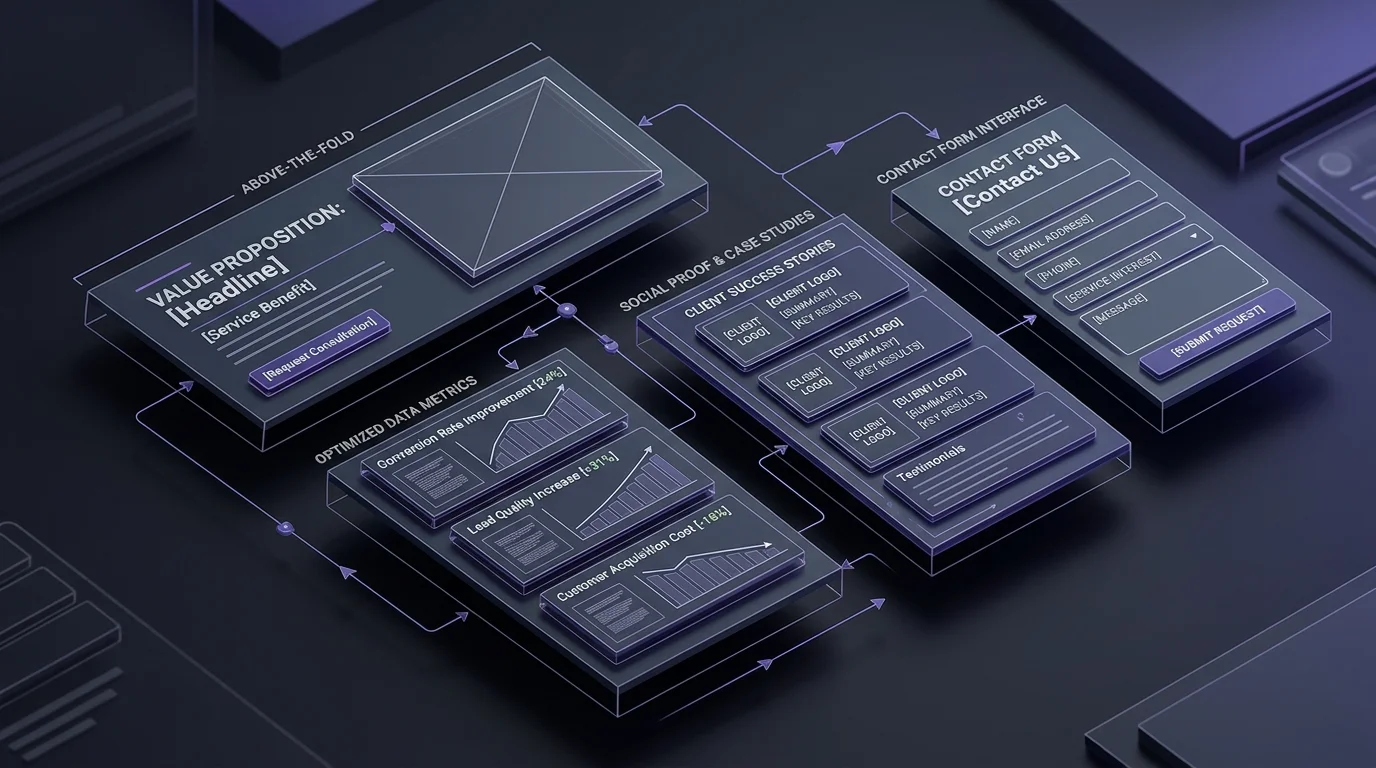
| 1. Above-the-Fold Hero | Confirm search intent and establish immediate commercial relevance. | Single clear H1 headline, concise 2-sentence value proposition, primary CTA button, and immediate micro-trust badges (e.g., client logos or ratings). |
| 2. The Problem We Solve | Demonstrate deep understanding of the client's current pain points. | Clear breakdown of 3–4 specific business symptoms, operational bottlenecks, or revenue losses the buyer is currently experiencing. |
| 3. The Solution & Scope | Define exact deliverables, capabilities, and methodology. | Structured feature-to-benefit breakdown, modular service tiers or packages, and clear scope boundaries. |
| 4. Proof & Case Studies | Eliminate buyer skepticism with verifiable past performance. | Contextual client testimonials with full attribution, mini case studies with quantified business outcomes, and verified client logos. |
| 5. Working Process / Roadmap | Demystify engagement and reduce fear of the unknown. | Simple 3-to-4 step process timeline (Discovery → Strategy → Execution → Launch & Support). |
| 6. Objection-Handling FAQs | Address common friction points and support search AEO. | 5–7 direct, unambiguous answers covering timelines, pricing factors, onboarding prerequisites, and technical considerations. |
| 7. Primary Conversion Block | Capture high-intent commercial contact details. | Dedicated low-friction inquiry form, direct telephone and email links, response time commitment, and privacy reassurance. |
Differentiating Benefits from Features on Commercial Pages
A classic copywriting flaw on technical service pages is confusing technical features with commercial business benefits. Features explain what your service includes; benefits explain why that feature matters to the buyer's bottom line.
Compare how technical features should be translated into commercial outcomes:
- Feature (Weak): "We build responsive websites using custom PHP and semantic HTML5 code."
Benefit (Strong): "Our custom-engineered architecture delivers sub-second page loads that reduce mobile drop-off and support higher Google search rankings." - Feature (Weak): "We conduct comprehensive technical SEO audits and keyword gap analyses."
Benefit (Strong): "We uncover and fix the hidden technical barriers preventing your high-margin service pages from ranking for commercial buyer queries." - Feature (Weak): "We design custom brand guidelines and typography palettes."
Benefit (Strong): "We establish a cohesive visual identity that commands premium market positioning and builds instant credibility with enterprise clients."
Every time you list a technical capability, ask yourself: "So what? How does this increase revenue, protect operational bandwidth, or reduce business risk for our client?" Answer that question directly in your body copy.
Integrating Strategic Internal Links to Guide the Buyer Journey
A service page should never exist as an isolated digital island. High-converting service pages serve as central hubs connected to supporting content across your website. Integrating thoughtful contextual internal links accomplishes two goals: it distributes organic search authority and guides prospects deeper into your conversion funnel.
Follow these internal linking best practices on your service pages:
- Link Horizontally to Complementary Services: If a prospect is reviewing your custom web development services, they frequently require complementary solutions such as strategic search engine optimization or dedicated website designing to maximize their investment. Linking between related service offerings increases deal size and user retention.
- Link Downward to Supporting Editorial Proof: Support your service claims by linking contextually to in-depth educational resources that diagnose specific problems, such as our guide to diagnosing website traffic with no leads or our strategic framework on website redesign vs rebuild decisions.
- Link Upward to Clear Conversion Channels: Ensure every service page provides direct, contextual pathways to your primary contact and project discovery page.
Measuring and Iterating Service Page Performance
Optimization is an ongoing discipline, not a one-time launch task. Once your service page is structured, configure your analytics platform to monitor these four critical commercial metrics:
- Service Page Scroll Depth and Engagement: Are visitors reading past the hero section? If 70% of users bounce before reaching your service scope or proof blocks, your above-the-fold headline and value proposition require immediate revision.
- Form Interaction vs. Form Completion: Track how many users click into your inquiry form fields compared to how many complete the submission. A high abandonment rate indicates unnecessary form fields or technical mobile friction.
- Assisted Conversion Paths: Use multi-touch attribution reports to understand how service page visits contribute to downstream inquiries across multiple sessions.
- Qualified vs. Unqualified Inquiry Ratio: High inquiry volume is counterproductive if your sales team spends all their time filtering out low-budget inquiries or out-of-scope requests. If inquiries are unqualified, refine your positioning to clearly state your target client profile and minimum engagement parameters.
Frequently Asked Questions (AEO)
What is service page optimization?
Service page optimization is the process of structuring, writing, and designing a commercial website page to rank for high-intent search queries and convert visitors into qualified sales inquiries. It combines search engine optimization (keyword targeting, schema, headings) with conversion rate optimization (value propositions, social proof, objection handling, and clear calls to action).
How long should a commercial service page be?
There is no arbitrary word count requirement for service pages. The page should be exactly as long as necessary to satisfy the search query, define the scope of work, demonstrate technical competence, neutralize common buyer objections, and provide compelling proof. Typically, comprehensive B2B service pages range between 1,000 and 1,800 words to provide both deep informational depth for search engines and thorough clarity for decision-makers.
Should pricing be listed on B2B service pages?
While bespoke enterprise services often cannot list exact flat fees due to variable project scopes, providing starting-at baselines, typical investment ranges, or transparent explanations of pricing variables is highly recommended. Transparent pricing filters out unqualified leads, builds instant credibility, and eliminates buyer anxiety about predatory sales discussions.
How many calls to action (CTAs) should a service page have?
A high-performing service page should focus on one primary commercial action (such as "Schedule a Technical Consultation" or "Request a Project Estimate") repeated at logical intervals: above the fold in the hero, mid-page following your methodology or case study proof, and at the bottom following the FAQ block. Avoid competing CTAs (such as asking users to simultaneously subscribe to a newsletter, follow a social channel, and request a quote) that divide user focus.
What is the most important element above the fold on a service page?
The most critical above-the-fold element is an unambiguous value proposition headline. A visitor must understand within five seconds exactly what your service is, who it is designed for, and what primary operational problem it solves. Pair this headline with a concise supporting paragraph, a prominent inquiry button, and immediate proof points (such as verified client logos or review ratings).
Maximize Your Commercial Service Inquiries With Digitons Development
Driving organic and paid traffic to underperforming service pages wastes marketing budget and leaves valuable market share on the table. Your commercial service pages should operate as your company's most productive, persuasive sales representatives around the clock.
At Digitons Development, we combine deep search engineering with strategic conversion architecture. We design and build high-performance service pages that capture commercial search demand, demonstrate undeniable expertise, and generate qualified enterprise inquiries.
Explore our results-driven search engine optimization services, discover our bespoke custom web development capabilities, or contact Digitons Development today to schedule a strategic service page evaluation.
Ready to turn these ideas into results?
Let's discuss how tailored digital marketing, custom web engineering, and targeted SEO can accelerate your business goals.