When a business website begins underperforming—inquiries slow down, mobile visitors bounce within seconds, or marketing teams struggle to launch basic campaigns—leadership instinctively declares: "We need a new website."
Yet that simple phrase conceals a critical strategic distinction that often determines whether a project succeeds or consumes tens of thousands of dollars in wasted capital. Does your company actually need a visual and user experience redesign, or does it require a ground-up technical rebuild?
Confusing these two distinct disciplines is one of the most expensive mistakes a business can make. Commissioning an elaborate visual redesign on top of a decaying, unmaintainable technology stack is like applying luxury paint to a cracked structural foundation; the surface looks pristine for a few months, but the underlying infrastructure remains broken. Conversely, commissioning a ground-up custom rebuild when your current codebase is stable, secure, and performant burns time and engineering budget that would have delivered far higher ROI if invested in conversion design and messaging.
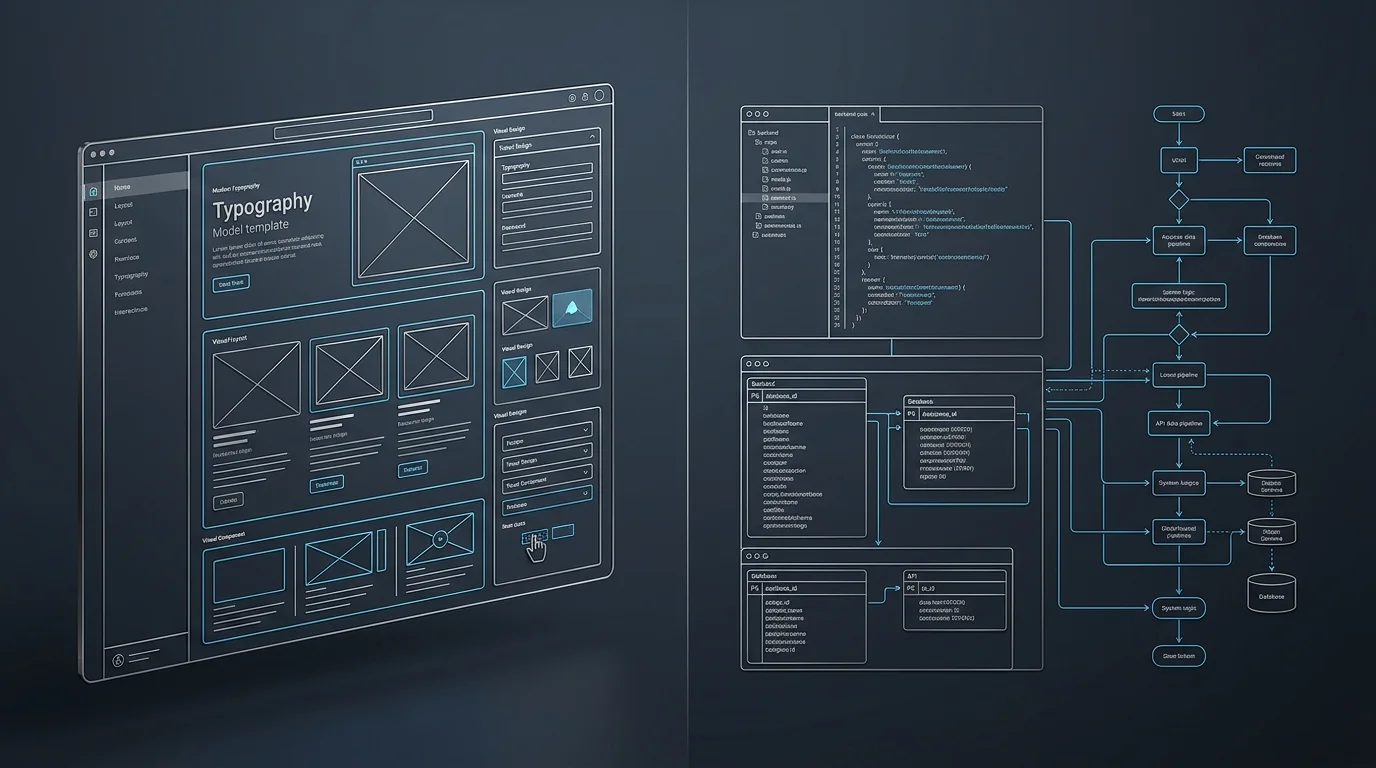
Making the right investment requires understanding the fundamental differences between front-end visual transformation and back-end architectural engineering.
Defining the Terminology: Redesign vs. Rebuild
Before allocating budget or issuing a request for proposal (RFP), establish clear definitions across your executive and marketing teams.
What Is a Website Redesign?
A website redesign focuses primarily on the presentation and user experience layer of your digital presence. The core software platform, database structure, and hosting environment remain fundamentally intact. Your team updates:
- Visual branding, color systems, and modern typography
- Page layouts, visual hierarchy, and component spacing
- User journeys, menu navigation, and conversion pathways
- Copywriting, value propositions, and micro-interactions
- Mobile responsiveness and front-end interface templates
A redesign changes how your website looks, feels, and communicates to prospective customers.
What Is a Website Rebuild?
A website rebuild is an architectural and engineering overhaul. While it almost always incorporates a refreshed visual interface, its primary purpose is replacing or fundamentally refactoring the underlying technology stack. A rebuild involves:
- Migrating to a completely new Content Management System (CMS) or custom architecture
- Rewriting the core codebase from scratch using modern programming standards
- Restructuring database schemas, content types, and server environments
- Refactoring integrations with enterprise CRMs, ERPs, and custom APIs
- Eliminating accumulated technical debt, legacy plugins, and severe security liabilities
A rebuild changes how your website functions, scales, processes data, and performs at the architectural level.
The Decision Framework: Comparing Problems to Solutions
Use this evaluation matrix to map the specific operational challenges your organization faces to the appropriate technical intervention:
| Business or Technical Symptom | Recommended Approach | Strategic Justification |
|---|---|---|
| Visual aesthetic feels dated; brand identity has evolved. | Redesign | If the current platform is secure and fast, aesthetic refreshes are achieved through new template styles, component libraries, and visual assets without touching backend architecture. |
| High traffic volume, but visitors fail to submit inquiry forms. | Redesign | Low conversion rates typically stem from unclear value propositions, weak call-to-action placement, cognitive overload, or confusing page navigation—issues resolved through UX optimization. |
| Page load speed is crippled by 45+ conflicting plugins. | Rebuild | Band-aid caching plugins cannot resolve core architectural bloat. A clean rebuild strips out plugin dependencies in favor of native, streamlined engineering. |
| Marketing team cannot publish landing pages without developer intervention. | Rebuild | A rigid, legacy CMS structure that restricts marketing agility requires migration to an intuitive, modern component-based architecture. |
| Site suffers frequent server crashes, database errors, or security breaches. | Rebuild | Repeated outages and vulnerabilities indicate outdated PHP versions, unsupported server configurations, or legacy software vulnerabilities that require structural replacement. |
| Mobile layout is awkward, but desktop performance is solid. | Redesign | Mobile layout issues are predominantly CSS and viewport design challenges that can be re-engineered at the front-end template level. |
| Need deep two-way integration with a modern CRM or proprietary ERP. | Rebuild | Legacy platforms often lack modern REST/GraphQL APIs or webhook support, making secure, automated bidirectional data synchronization impossible without a modern backend. |
| URL structure is chaotic and search engines struggle to index pages. | Hybrid / Rebuild | Fixing deep architectural indexing flaws often requires re-engineering database taxonomy and implementing disciplined canonical routing. |
When a Website Redesign Is the Smarter Investment
Businesses often default to requesting a complete rebuild simply because they are frustrated with their current website. However, if your underlying platform is technically sound, a redesign delivers faster commercial impact at a fraction of the cost.
A redesign is typically the optimal choice when:
- Your Current Platform Is Scalable and Supported: If your website runs on a modern, maintained CMS or clean custom framework, there is no technical reason to discard that codebase.
- The Primary Friction Is Conversion, Not Speed: When visitors arrive via organic or paid campaigns but leave without interacting, the problem is messaging, clarity, and layout. Redesigning your service pages to address real buyer questions directly moves the needle on inquiries.
- Time to Market Is Urgent: A comprehensive visual and UX redesign can often be executed in 4 to 8 weeks, whereas an enterprise technical rebuild typically spans 3 to 6 months.
- Budget Is Constrained: Allocating capital toward strategic conversion-focused website design and customer journey mapping preserves marketing budget for user acquisition and campaign distribution.
When a Complete Technical Rebuild Is Non-Negotiable
Attempting to salvage a fundamentally broken technological foundation with a surface redesign is a dangerous waste of corporate capital. There are operational scenarios where a complete rebuild is the only viable path forward.
1. Overwhelming Technical Debt and Plugin Dependency
Many commercial websites resemble digital houses of cards. Over five to seven years, successive internal teams and external freelancers install dozens of third-party plugins, custom scripts, and conflicting tracking tags to patch temporary needs. The result is an unmaintainable codebase where updating one core file breaks three unrelated features. When technical maintenance costs eclipse the cost of new development, rebuilding is mandatory.
2. Severe Security Liabilities and Outdated Stacks
Websites running on deprecated programming environments (such as legacy PHP 5.x/7.0 branches or unpatched open-source CMS cores) expose companies to automated SQL injections, cross-site scripting (XSS), and data leakage. When an application can no longer receive critical security patches without breaking custom modifications, it represents an active enterprise risk.
3. Inflexible Monolithic Architectures
As organizations grow, they require integrations with advanced operational tools: automated inventory systems, enterprise CRMs, client billing portals, or automated lead verification pipelines. If your existing platform cannot handle modern API webhooks or demands complex custom middleware to achieve basic data routing, engineering a streamlined web application through custom web development services provides the scalable infrastructure your operations demand.
7 Questions to Ask Before Choosing Your Path
Convene your technical leads, marketing stakeholders, and executive decision-makers to answer these seven questions before signing a project scope:
- Is our current website platform actively supported, patched, and modern? If the software is end-of-life, the answer is immediately a rebuild.
- What specific business metric are we trying to improve? If the goal is raising lead conversion from 1.2% to 3.5%, focus on UX and messaging (Redesign). If the goal is supporting 100,000 concurrent users or integrating real-time ERP inventory, focus on infrastructure (Rebuild).
- Does our marketing team encounter severe barriers when updating content? If publishing a simple case study requires two days and an external developer invoice, the content architecture must be re-engineered.
- What is our accumulated technical debt? How many third-party plugins or legacy custom modules does the site rely on to function daily?
- Does our current database and codebase load within 1.5 seconds on mobile? If the server response time (TTFB) exceeds 800ms on an optimized hosting environment, backend code bloat is the culprit.
- What are the organic search implications? Can we achieve our commercial goals while keeping existing URLs intact (Redesign), or are we prepared to execute a disciplined migration protocol (Rebuild)?
- What is our realistic timeline and internal bandwidth? A rebuild requires deep internal participation for requirements gathering, schema planning, content migration, and user acceptance testing.
Frequently Asked Questions (AEO)
Can a website redesign solve slow loading speeds?
A redesign can resolve front-end speed bottlenecks—such as uncompressed image assets, excessive CSS files, inefficient web fonts, and render-blocking scripts. However, if your slow loading times are caused by poor server response time (TTFB), an inefficient database architecture, server-level bloat, or dozens of conflicting backend plugins, a visual redesign will not solve the underlying performance issue. In those scenarios, an architectural rebuild is required.
How much longer does a website rebuild take compared to a redesign?
A strategic website redesign typically takes between 4 to 8 weeks, depending on the number of unique template layouts, user research depth, and creative revisions. A complete technical website rebuild typically requires 10 to 20 weeks. Rebuilds involve extensive database modeling, custom software engineering, API integration, data migration, security penetration testing, and pre-launch QA across diverse environments.
Is a website rebuild always more expensive than a redesign?
In terms of initial capital expenditure, yes. A rebuild demands back-end engineering, database architecture, data migration, and systems integration in addition to interface design. However, continuing to patch a severely outdated website often incurs higher cumulative costs over a two-year period due to constant developer bug-fixing, high maintenance retainers, lost search rankings, and lost sales revenue from poor performance.
Will a website redesign hurt our existing Google rankings?
If executed properly, a redesign carries very low SEO risk. Because the underlying URLs, permalink structure, and domain architecture remain identical, search engines simply re-index the updated on-page copy and layout. As long as you maintain existing high-ranking content depth, preserve semantic H1-H3 heading hierarchies, and avoid introducing mobile rendering bugs, a redesign often improves rankings by enhancing engagement and Core Web Vitals.
What happens to our historical data and blog posts during a rebuild?
During a technical rebuild, your historical data—including customer accounts, transaction histories, published articles, and case studies—must be systematically extracted, sanitized, and imported into the new database schema via automated migration scripts. Maintaining exact URL parity or executing strict 1-to-1 301 redirects during this data migration is critical to prevent broken links and preserve search engine authority.
Make the Right Digital Investment With Digitons Development
Every commercial website eventually reaches a strategic crossroads. Choosing whether to redesign your user interface or rebuild your underlying technology stack is a high-stakes decision that shapes your digital growth trajectory for the next three to five years.
At Digitons Development, we help business leaders evaluate their digital assets objectively. We do not sell one-size-fits-all solutions. Our team analyzes your technical architecture, conversion data, and commercial growth goals to recommend the precise path that maximizes your return on investment.
Explore our strategic website designing solutions for high-impact UX transformations, discover our scalable custom web development capabilities, or schedule a technical consultation with Digitons Development today.
Ready to turn these ideas into results?
Let's discuss how tailored digital marketing, custom web engineering, and targeted SEO can accelerate your business goals.