
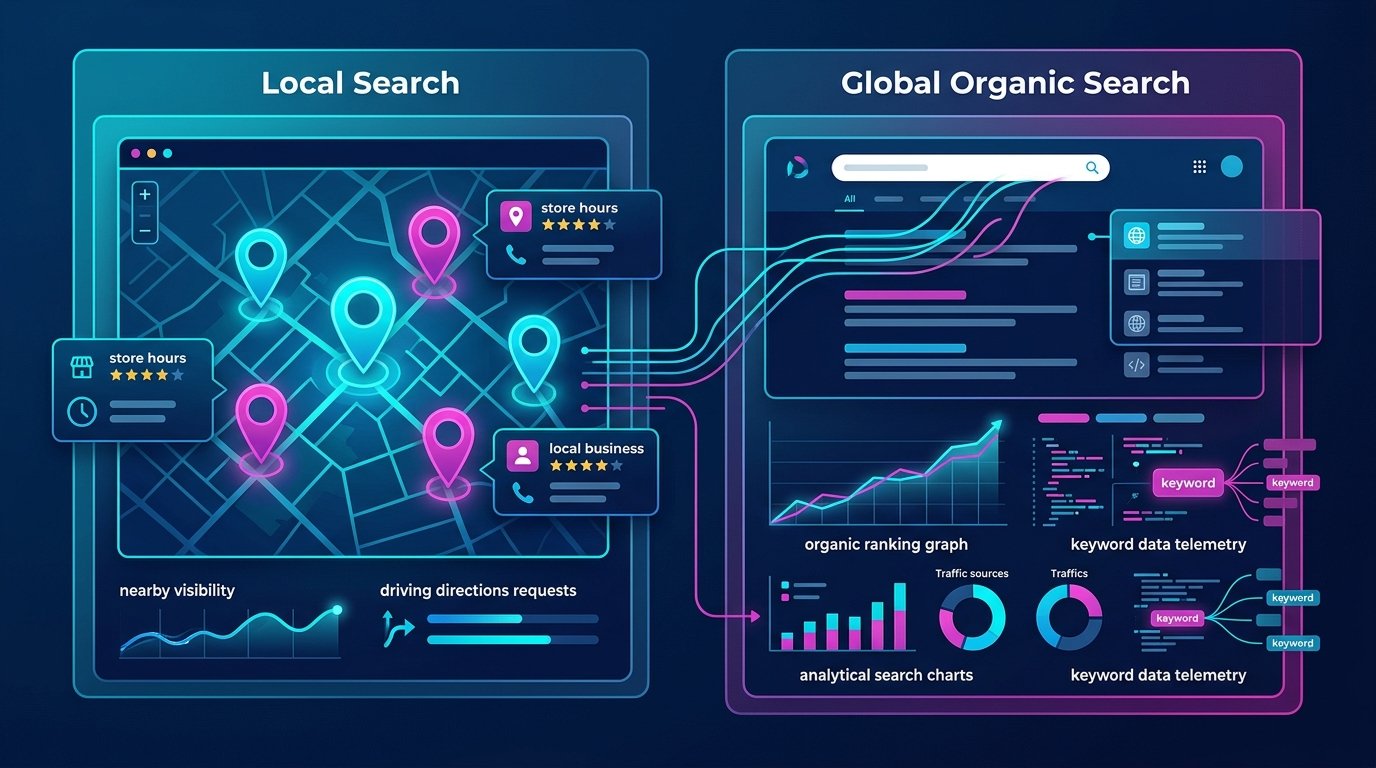
Search engine optimization (SEO) is one of the highest-ROI growth channels available to modern businesses. When prospective customers search for solutions, products, or professional services, appearing prominently at the exact moment of commercial intent creates a predictable stream of qualified inbound leads and revenue. However, many business owners and marketing teams face a fundamental strategic question: Should we invest in Local SEO, Traditional SEO, or a hybrid approach?
While both disciplines share core principles—such as crawlability, keyword relevance, high-quality content, and technical excellence—their execution, algorithmic ranking factors, geographical targeting, and conversion paths differ substantially. Choosing the wrong strategy can lead to wasted budget, misplaced effort, and missed revenue opportunities.
Understanding the Basics: What Is Search Engine Optimization?
At its core, search engine optimization is the practice of enhancing a website’s technical architecture, topical authority, content depth, and backlink profile so that search engines like Google rank its pages prominently for relevant search queries. SEO captures high-intent organic demand from prospects who are actively seeking answers, comparisons, or service providers.
Within the broader umbrella of organic search marketing, search engines treat localized queries and non-localized informational/national queries through separate ranking algorithms and distinct Search Engine Results Page (SERP) features.
What Is Local SEO?
Local SEO is the process of optimizing your online presence to attract customers from a specific geographic area, neighborhood, city, or metropolitan region. It is designed specifically for businesses with physical storefronts, brick-and-mortar locations, or dedicated service areas.
When a user conducts a search with explicit local intent (such as "commercial interior designer in Connaught Place") or implicit local intent (such as "web development agency near me" on a mobile phone), Google triggers the Local Map Pack (Google Maps 3-Pack) alongside localized organic results.
Key pillars of Local SEO include:
- Google Business Profile (GBP) Optimization: Claiming, verifying, and actively managing your GBP profile with accurate business categories, service menus, operating hours, high-resolution photos, and regular updates.
- Local Citations & NAP Consistency: Ensuring your business Name, Address, and Phone number (NAP) are identical across local directories (Justdial, Sulekha, IndiaMART, Yelp, YellowPages), industry portals, and mapping platforms.
- Customer Reviews and Reputation Management: Generating authentic customer reviews, maintaining a high star rating, and responding professionally to all feedback.
- Geo-Targeted Landing Pages: Developing dedicated service-area pages optimized for specific towns, districts, or suburban hubs.
What Is Traditional (Organic) SEO?
Traditional SEO (often referred to as National, Global, or Organic SEO) focuses on ranking web pages in organic search results without geographical constraints. Its primary objective is to build domain-wide topical authority, capture informational and commercial search volume, and drive qualified traffic from nationwide or international audiences.
Traditional SEO is the primary growth engine for e-commerce stores, SaaS platforms, B2B software vendors, remote service providers, publishers, and national corporations. Rather than relying on physical map listings, traditional SEO competes directly in the standard blue-link organic search results.
Key pillars of Traditional SEO include:
- Topical Authority and Content Strategy: Creating in-depth educational guides, pillar pages, comparison articles, and case studies through strategic content marketing and editorial planning.
- Technical Infrastructure: Ensuring rapid page speeds, clean indexation, structured schema markup, and seamless mobile responsiveness through robust clean-code web development.
- High-Authority Backlink Acquisition: Earning editorial mentions, press coverage, and industry citations from authoritative digital publications.
- Search Intent Mapping: Structuring website architecture to answer informational (top-of-funnel), commercial investigation (mid-funnel), and transactional (bottom-of-funnel) user queries.
Key Differences: Local SEO vs Traditional SEO
To choose the right path, businesses must evaluate how the two strategies differ across fundamental operational dimensions:
| Dimension | Local SEO | Traditional (Organic) SEO |
|---|---|---|
| Geographic Scope | Hyper-local, city, district, or defined radius | National, multi-regional, or global |
| Primary Search Features | Google Map Pack (3-Pack), Local Finder, Google Maps | Standard organic listings, Featured Snippets, Knowledge Panels |
| Core Ranking Factors | Proximity, GBP relevance, NAP consistency, local reviews | Domain authority, backlink quality, content depth, technical health |
| Conversion Mechanism | Phone calls, direction requests, foot traffic, local booking forms | Digital lead forms, e-commerce checkouts, software trials, downloads |
| Time to Initial Results | Typically 1 to 3 months for local map visibility | Typically 4 to 9 months for competitive national keywords |
| Competition Density | Local area competitors in your specific geography | Every website competing for the keyword worldwide |
Search Intent: How Google Differentiates Queries
Google’s ranking algorithms determine whether to display local or traditional results based on user search intent. Search intent is categorized into two main branches:
1. Implicit and Explicit Local Intent
When a user queries "IT support company near me" or "corporate lawyer Delhi", Google recognizes explicit local intent. Even if the user simply searches "plumber" without specifying a city, Google uses the device’s IP address, GPS coordinates, and Wi-Fi triangulation to serve nearby service providers in the Map Pack.
2. Informational and Non-Geographic Intent
When a user searches "how does cloud migration work" or "best CRM software for small businesses", location is irrelevant. Google evaluates content comprehensiveness, authoritativeness, and domain trust, displaying national guides and industry solutions.
Which Search Strategy Fits Your Business Model?
Selecting the optimal search strategy depends entirely on how your business delivers its products or services and where your target customers reside:
1. Physical Storefronts and Brick-and-Mortar Locations
Primary Strategy: Local SEO. Retail stores, medical clinics, legal practices, restaurants, automotive centers, and local boutiques rely overwhelmingly on foot traffic and nearby calls. Ranking #1 in the Google Map Pack for nearby searches generates immediate revenue.
2. Service-Area Businesses (SABs)
Primary Strategy: Local SEO with Regional Landing Pages. Plumbers, commercial cleaning agencies, HVAC contractors, and local IT consultants serve clients at their homes or offices across a defined territory (e.g., Delhi, Noida, Gurugram, and Faridabad). Local SEO paired with dedicated location landing pages ensures visibility across every target municipality.
3. E-Commerce and Digital Product Companies
Primary Strategy: Traditional SEO. Online retailers selling physical products nationwide or digital downloads do not require local foot traffic. They need traditional e-commerce SEO, category page optimization, product schema markup, and broad keyword rankings across national search queries.
4. B2B Enterprises and High-Growth Tech Companies
Primary Strategy: Hybrid Approach. Many enterprise agencies, corporate consultancies, and technology firms operate physical headquarters while serving national and global enterprise accounts. A hybrid approach captures high-intent local corporate contracts in their home metropolitan area while building broad topical authority for global service offerings.
Why Many Businesses Benefit from a Combined Hybrid Strategy
Local SEO and Traditional SEO are not mutually exclusive. In fact, they create powerful mutual reinforcement when deployed together:
- Double SERP Real Estate: A business executing a hybrid strategy can simultaneously capture the #1 position in the Google Map Pack and the #1 position in organic blue-link results for high-value localized commercial queries.
- Topical Authority Elevates Local Rankings: Publishing authoritative blog articles and educational content builds overall domain authority, which directly strengthens the organic ranking power of your localized service landing pages.
- Multi-Location Scalability: Growing enterprises can replicate proven Local SEO frameworks across new branch offices while maintaining a centralized national domain.
Executing an integrated strategy through comprehensive search engine optimization services ensures your brand captures every segment of your total addressable search market.
Measuring and Evaluating SEO Performance
Because the conversion goals of Local and Traditional SEO differ, tracking meaningful Key Performance Indicators (KPIs) is essential. Tracking should be configured through robust web analytics and performance tracking rather than relying on vanity metrics:
Key Local SEO Metrics:
- Google Business Profile Discovery & Direct Search Impressions.
- Direct phone calls initiated from GBP listings.
- Driving direction requests and website clicks from Google Maps.
- Map Pack ranking positions across a multi-point geo-grid tracker.
Key Traditional SEO Metrics:
- Organic non-brand traffic growth and keyword visibility across national SERPs.
- Domain authority and high-quality referring domain acquisition.
- Organic conversion rates, form submissions, and assisted revenue attribution.
- Average position and click-through rates (CTR) in Google Search Console.
Common SEO Mistakes Businesses Must Avoid
Avoid these frequent strategic pitfalls that derail search campaigns:
- Targeting National Keywords as a Purely Local Business: A local dental clinic in Delhi trying to rank globally for "teeth whitening tips" will waste resources attracting non-converting traffic from other continents instead of nearby patients.
- Ignoring Google Business Profile Consistency: Discrepancies in address formatting, incorrect phone numbers, or abandoned profiles severely suppress Map Pack rankings.
- Creating Thin Duplicate City Pages: Generating dozens of identical pages with only the city name swapped violates search quality guidelines and risks algorithmic devaluation.
- Neglecting Technical Page Health: Heavy page load times and broken mobile layouts damage both local and national ranking potential.
Practical Decision Framework: Local vs. Traditional SEO
Ask these four diagnostic questions to determine your primary focus:
- Do your customers physically visit your office or do you travel to meet them locally? If yes $ ightarrow$ Prioritize Local SEO.
- Can your product or service be delivered digitally anywhere regardless of location? If yes $ ightarrow$ Prioritize Traditional SEO.
- Do you operate in a high-density metropolitan market (such as Delhi/NCR) while targeting wider national corporate accounts? If yes $ ightarrow$ Deploy an Integrated Hybrid Strategy.
- What is your immediate growth timeframe? If you need immediate nearby leads in 30–60 days $ ightarrow$ Start with Local SEO & GBP Optimization before scaling long-term national organic campaigns.
Frequently Asked Questions (FAQ)
Can a business do Local SEO without a physical office?
Yes. Service-Area Businesses (SABs) that deliver services directly to customers (such as electricians, event planners, or home consultants) can create a Google Business Profile with their physical address hidden, defining specific geographic service zones instead.
Which is more expensive: Local SEO or Traditional SEO?
Traditional SEO generally requires a larger ongoing investment because it competes against a much broader, national pool of competitors and requires extensive content production and authority link building. Local SEO is typically more cost-effective with faster initial ROI.
How long does it take to see results from Local SEO?
Optimizing Google Business Profiles and local citations often produces measurable ranking improvements within 4 to 12 weeks, depending on local competition density and existing review volume.
Do online reviews affect traditional organic rankings?
Google reviews are a primary ranking factor for the Local Map Pack. While they do not directly dictate national organic blue-link rankings, high review scores significantly increase user trust, click-through rates, and on-page conversion rates.
Can e-commerce stores benefit from Local SEO?
Only if the e-commerce business also operates physical retail stores, showrooms, or local fulfillment pick-up points. Pure-play online stores without physical customer touchpoints should focus 100% on Traditional SEO and e-commerce optimization.
Conclusion and Next Steps
Choosing between Local SEO and Traditional SEO is not a matter of which strategy is universally superior—it is about selecting the approach that aligns precisely with your business model, service delivery radius, and commercial growth targets. By focusing your resources on the right search channels, you can dominate search results, outpace competitors, and generate consistent, high-intent customer acquisition.
Ready to unlock sustainable search growth? Partner with Digitons Development for data-driven Local SEO, nationwide organic campaigns, and complete enterprise digital marketing solutions engineered for measurable commercial impact.
Ready to turn these ideas into results?
Let's discuss how tailored digital marketing, custom web engineering, and targeted SEO can accelerate your business goals.